
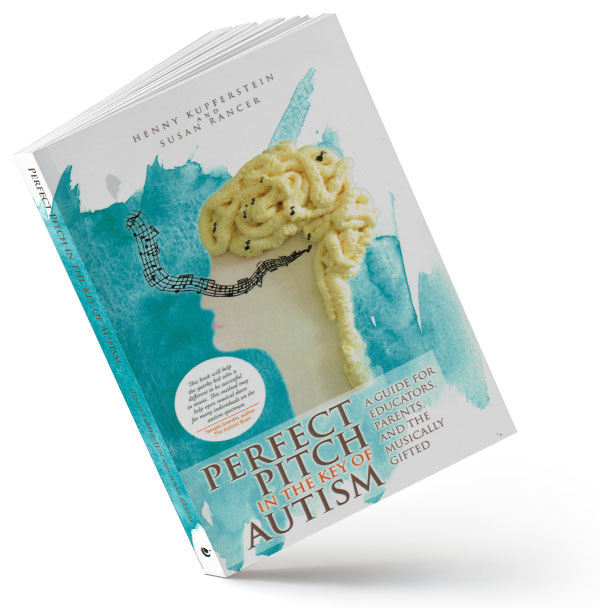
Authors: Henny Kupferstein, Susan Rancer
Autistic people and musical individuals often have perfect pitch, a gift they were born with. The musical gift may be accompanied with learning differences such as reading comprehension problems, trouble with mathematics, and significant difficulties in learning how to read music The authors combined many years of teaching experience to develop a research-based method that maximizes students’ gifts to advance their musicianship.
Topics include:
- The definition of perfect pitch and relative pitch, and the different levels of these abilities.
- How to test and determine if someone has perfect pitch and relative pitch
- How to modify instructions for those students.
- Problems that arise as a result of having perfect pitch and/or relative pitch.
This book will help the quirky kid who is different to be successful in music. This method may help open musical doors for many individuals on the autism spectrum.
Temple Grandin, author of Thinking in Pictures and The Autistic Brain.
Frequently Asked Questions
Why is understanding perfect pitch so important?
Individuals with any degree of perfect pitch learn differently than those without it. If taught using conventional methods, students in the perfect pitch spectrum may become unmotivated and their talents could be left undeveloped. However when these students are encouraged appropriately, musical talent may blossom in dramatic ways. Flexibility is absolutely essential when teaching those with perfect pitch because these students process information differently. Teachers without perfect pitch sometimes misconstrue behavioral or learning problems in students when they should, in fact, be respecting a gift.
What is relative pitch?
There are many different variations and degrees of pitch-matching ability. The most common of these variations is relative pitch, which is the ability to identify a pitch once a leading tone is provided as a reference point.
(Note that everyone within the perfect pitch spectrum also possesses relative pitch.)
How would I know if my child has perfect or relative pitch? How to identify perfect and relative pitch
- When playing an instrument, the person tries to play songs "by ear".
- The person can transpose a piece from one key to another instantaneously.
- Despite a musical ability and an ability to read text, the person may be a poor visual reader of musical notation.
What is Susan’s pedagogy or teaching approach?
- Susan Rancer makes use of her extensive knowledge of perfect and relative pitch in her teaching. She uses this knowledge to customize an individual teaching plan for each of her students.
- In addition, Susan is keenly aware of the deficits that each of her students has. She structures her teaching to reinforce the goals of the Individualized Education Plan, or IEP. Susan uses music to reinforce the non-musical goals of each student’s IEP.
- To find more information about how a music teacher understands these children, read Susan Rancer's book "Perfect Pitch in the Key of Autism".